
For more than five decades, Rodney Sutton has learned from traditional musicians and dancers, performed alongside them, taught others what he learned and helped carry Appalachian dance traditions to new generations.
This fall, the Bascom Lamar Lunsford Mountain Music Festival at Mars Hill University will recognize those contributions by presenting Sutton with the Bascom Lamar Lunsford Award.
Established in 1980, the award honors individuals who have made significant contributions to the folk, musical and/or dance traditions of the Southern Appalachian mountain region. Sutton’s work encompasses all three.
“Rodney deserves this award for so many reasons that I’m not sure where to start,” said Leila Weinstein, Lunsford Festival director. “I think I’ll start by saying that Rodney is a tender. He tends to traditional music and its people in a gentle and nurturing way—a tender tender, if you will.”
Sutton’s connection to traditional dance began long before he knew what clogging was. Growing up in eastern North Carolina, he went to community dances with his parents. As a student at East Carolina University in the early 1970s, he noticed a young man dancing around the cafeteria and asked him about the steps. The dancer, Earl, was a member of the Green Grass Cloggers, a young college group that had recently won a world championship.
Sutton went to see the group perform and asked if they needed another male dancer. He soon found himself trying to learn a style of clogging that was very different from the community dances of his childhood. He struggled.
After showing Sutton the basic step, Green Grass founder Dudley Culp spent less than 10 minutes trying to teach him before telling him, “I don’t think you’ll ever make a clogger.”
Sutton didn’t give up. He practiced the step repeatedly with another dancer, eventually learning it well enough to join Green Grass. That experience would shape his approach to teaching.
“Even though I didn’t know how to teach it, I was determined I would never tell anybody they couldn’t dance,” Sutton said.
He began breaking the movements down into manageable pieces, teaching the basic weight shift before adding more complicated elements. Eventually, he perfected that teaching technique.
“I can teach the average person walking through here that Green Grass Clogger basic step in about 15 minutes,” Sutton said. “Just the pattern of it.”
Teaching became as important to Sutton as performing. Green Grass traveled widely, performing at festivals and teaching workshops. Sometimes the group’s success as teachers came back to bite them: they would return to a festival the following year and discover that people who had attended their workshops had formed local teams of their own.
“You taught your way out of a job,” the interviewer told Sutton. “Yeah, we did. We did,” Sutton replied. Sutton estimates Green Grass inspired 10 or 15 teams in that way.
Weinstein said Sutton’s contributions have gone well beyond performing.
“He has helped preserve traditional music in part by performing it,” she said. “He’s a gifted performer, both in an ensemble, like the Green Grass Cloggers and Fiddle Puppets, but also as a solo dancer, storyteller, singer, and caretaker of possum-lore.”
Sutton has also spent decades learning directly from older tradition bearers, collecting their dance steps, stories and songs and helping share their knowledge with others. Among those tradition bearers was his friend Bobby McMillon, a master ballad singer and storyteller whose extensive collection of ballad recordings is now housed in Mars Hill’s Southern Appalachian Archives.
“Baby Steps” by Jake Penrod, performed by Rodney Sutton and the Barely Hardly Enough Boys, 3-28-2026
Sutton’s own path has included performing with the Green Grass Cloggers, helping form the Fiddle Puppets, traveling throughout the United States and overseas, returning to Green Grass, and continuing to teach and document Appalachian dance. Through all of those experiences, he has remained focused on helping other people discover the pleasure of making music with their feet.
“It’s great when you’ve done a great performance and you’re getting all that immediate response,” Sutton said. “But what’s, to me, equally as great, or even more, is that you’re teaching something that somebody will have for the rest of their lives.”
That philosophy has extended into Sutton’s own family. His daughter, Kelsey, grew up around dancing and eventually became a dancer herself. Recently, the two competed at the Appalachian String Band Festival in Clifftop, West Virginia. Sutton won his senior competition, while Kelsey won the open category. They then competed against each other for the grand championship. Kelsey won.
“Very emotional,” Sutton said. “Very proud.”
Kelsey later joined Green Grass for a performance at Asheville’s Shindig On the Green. Although she had never performed a Green Grass routine, she learned one after a single rehearsal.
“She could do all the steps,” Sutton said. “After it was over she says, ‘Well, I kicked on the wrong foot a couple of times.’” Nobody watching could tell, he said. She was “beaming and smiling and such a joy to watch dance.”
For Sutton, that kind of generational connection is at the heart of his work. He hopes to continue teaching, performing and documenting traditional music and dance, but his larger goal is to inspire people who will carry those traditions forward after him.
Weinstein said Sutton’s ability to make beginners feel welcome is another important part of his contribution.
“He loves teaching other people how to make music with their feet and has taught at workshops, camps, and festivals all over, always making sure to help beginners feel welcome and unintimidated,” she said. “He’s a gifted square-dance caller and if you are lucky enough to have actually gotten to dance with Rodney at a square dance, then you know that he has the unique ability to make you feel like a graceful and accomplished dancer.”
The Bascom Lamar Lunsford Award recognizes Sutton’s contributions over more than five decades. But his own attention remains focused on what comes next.
“If I can, hopefully with videos and stuff, well, after I’m gone, inspire somebody else to continue to want to be a percussionist, flatfoot dancer,” Sutton said.
For Sutton, keeping a tradition alive has never meant keeping it still. It means learning it, sharing it and giving someone else the opportunity to carry it forward.
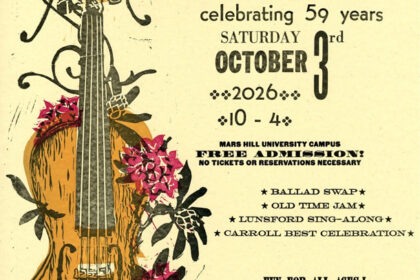
59th Annual Lunsford Festival
The Bascom Lamar Lunsford Mountain Festival brings together some of the region’s finest musicians and dancers for a day of performances, workshops, and impromptu jams on MHU’s Lunsford Commons. Festival hours are 10 a.m.–4 p.m. on Saturday, October 3, 2026. It’s the same day as the Madison Heritage Arts Festival, which also runs from 10 a.m.–4 p.m. in downtown Mars Hill. Admission to the festivals is free.
For updates and information, visit the festival website at www.mhu.edu/lunsfordfestival.